SSDI vs. SSI in 2026: Key Coverage Differences and Updated Asset Limits Explained
Advertisements
SSDI vs. SSI in 2026 involves important differences in eligibility, work history, income rules, and healthcare coverage. The Social Security Administration confirmed a 2.8% cost-of-living adjustment for 2026, raising the maximum federal SSI payment to $994 for individuals and $1,491 for eligible couples. SSI resource limits remain $2,000 for individuals and $3,000 for couples.
Understanding SSDI vs. SSI in 2026 is essential for Americans evaluating disability benefits, financial eligibility, and available healthcare assistance.
Although both programs are administered by the Social Security Administration, they serve different purposes and follow different requirements concerning employment history and financial resources.
This guide explains the confirmed 2026 benefit amounts, resource limits, work requirements, healthcare differences, and application procedures using official SSA information.
Understanding SSDI vs. SSI in 2026
Social Security Disability Insurance (SSDI) and Supplemental Security Income (SSI) are federal programs that provide financial assistance to people meeting specific eligibility requirements.
SSDI generally supports qualifying workers with disabilities who have earned sufficient Social Security work credits, while SSI serves eligible people with limited income and resources.
Knowing the distinction between these programs helps applicants determine which benefits may apply to their circumstances and what documentation they need.
What Is Social Security Disability Insurance?
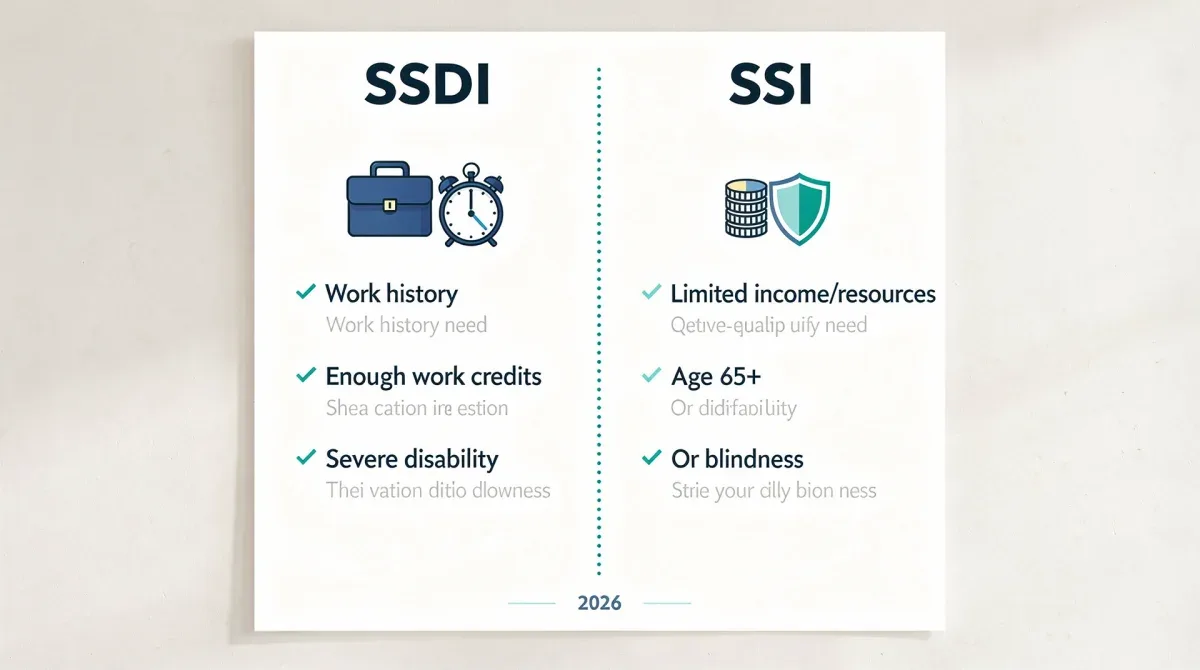
SSDI is an insurance-based federal benefit financed through Social Security payroll taxes paid by covered workers and employers.
Eligibility generally depends on a qualifying disability and sufficient work history, with specific credit requirements based on the age when disability began.
The amount paid is calculated using the worker's covered earnings record rather than a fixed payment available equally to all recipients.
What Is Supplemental Security Income?
SSI is a federal assistance program funded through general tax revenues rather than Social Security payroll taxes.
It provides monthly payments to eligible people with limited income and resources who are age 65 or older, blind, or have a qualifying disability.
Unlike SSDI, SSI does not require applicants to have previously worked or accumulated Social Security work credits.
Why the Differences Matter
A person may qualify for SSDI based on previous employment but fail to qualify for SSI because their countable financial resources exceed the applicable limit.
Another person may qualify for SSI without sufficient employment history to receive SSDI, provided the other program requirements are satisfied.
Some individuals may qualify for both programs, although their SSI payments are adjusted according to applicable income and resource rules.
SSDI Eligibility Requirements in 2026
SSDI applicants generally must satisfy both the Social Security Administration's disability definition and its insured-status requirements.
The program evaluates whether the applicant has accumulated sufficient work credits and whether the medical condition prevents substantial gainful activity under applicable rules.
These requirements remain central to the SSDI vs. SSI comparison because SSI does not use the same employment-based eligibility system.
Work Credits Required for SSDI
Workers earn Social Security credits through covered employment or self-employment income, with no more than four credits available during a calendar year.
In 2026, one credit requires $1,890 in covered earnings, meaning $7,560 can provide the maximum four credits for the year.
Many adults age 31 or older generally need at least 20 credits during the ten-year period preceding disability, while younger workers may qualify under different requirements.
Substantial Gainful Activity Limits for 2026
The Substantial Gainful Activity (SGA) threshold helps the SSA evaluate whether work activity meets the applicable disability program standards.
For 2026, the monthly SGA amount is $1,690 for individuals who are not statutorily blind and $2,830 for individuals meeting the statutory blindness definition.
These figures are particularly important for SSDI disability evaluations, although special work incentives and other program rules can affect individual situations.
How the SSA Evaluates Disability
The SSA generally evaluates whether an applicant has a medically determinable impairment that prevents qualifying substantial work activity.
For adult disability claims, the condition generally must have lasted or be expected to last at least 12 months, or be expected to result in death.
The agency reviews medical evidence, functional limitations, work history, and other applicable factors through its disability determination process.
SSI Eligibility Requirements and 2026 Resource Limits
SSI eligibility is based on financial circumstances and qualifying age, blindness, or disability criteria rather than previous contributions to Social Security.
Applicants must satisfy applicable income and resource rules, along with citizenship or qualifying immigration requirements and other conditions.
The federal resource limits have not increased for 2026, making accurate identification of countable resources particularly important.
Confirmed SSI Asset Limits for 2026
The maximum countable resource amount remains $2,000 for an eligible individual and $3,000 for an eligible couple in 2026.
These are resource thresholds rather than monthly income limits, and they apply to assets the SSA considers countable under program rules.
For additional information, readers can explore this guide to protecting SSI eligibility under resource limits.
Which Assets Usually Count Toward SSI?
Countable resources may include cash, money held in bank accounts, investments, and other property that can be converted to money for support.
The SSA evaluates ownership, availability, applicable exclusions, and certain resources associated with spouses or other household members.
Because the rules are detailed, applicants should not assume that all property they own automatically counts toward the SSI resource limit.
Which Assets May Be Excluded?
The home an applicant lives in and the land associated with that home are generally excluded from countable resources under SSI rules.
One vehicle used for transportation, household goods, personal effects, and certain other resources may also qualify for exclusions.
Special rules can apply to qualifying ABLE accounts, burial arrangements, and other designated assets, depending on individual circumstances.
ABLE Accounts and SSI Eligibility
Achieving a Better Life Experience (ABLE) accounts allow eligible people with disabilities to save funds under special federal and state program rules.
For SSI resource calculations, up to $100,000 in a qualifying ABLE account is generally excluded, subject to the applicable requirements.
Eligibility to establish an ABLE account and the treatment of withdrawals involve separate rules that should be reviewed before transferring funds.
SSDI Payment Amounts in 2026
SSDI payments depend on a worker's Social Security-covered earnings history and the benefit formula applied to that record.
Unlike SSI, there is no single monthly disability payment that every qualified SSDI recipient receives.
The SSA applies annual cost-of-living adjustments to qualifying Social Security benefits, including SSDI payments.
How SSDI Benefits Are Calculated
The SSA uses covered earnings information to calculate an Average Indexed Monthly Earnings (AIME) figure for an eligible worker.
This calculation contributes to determining the Primary Insurance Amount (PIA), which is used in establishing the monthly disability benefit.
The final amount depends on the individual's actual record and applicable adjustments rather than solely on their most recent salary.
Average SSDI Benefits in 2026
The SSA estimated that the average monthly payment to disabled workers would reach approximately $1,630 following the 2026 cost-of-living adjustment.
This amount represents an estimated average, not a minimum payment or a guarantee of what any particular recipient will receive.
Individuals can review their personal Social Security earnings record and available benefit estimates through the SSA's official services.
The 2026 Cost-of-Living Adjustment
The SSA announced a 2.8% cost-of-living adjustment for Social Security and SSI benefits effective for 2026.
This adjustment was determined using the relevant Consumer Price Index for Urban Wage Earners and Clerical Workers measurement period.
For more context, explore this guide to the 2026 Social Security COLA and the official figures published by the SSA.
SSI Payment Amounts in 2026
SSI has federal maximum monthly payment amounts that apply before reductions for countable income and certain other factors.
In 2026, the maximum federal payment is $994 for an eligible individual and $1,491 for an eligible couple.
Some states provide supplementary payments, while the actual amount an individual receives may be lower because of personal financial circumstances.
Federal SSI Payment Rates
The maximum federal individual SSI payment increased from $967 in 2025 to $994 in 2026 following the 2.8% COLA.
For an eligible couple, the maximum federal monthly payment increased from $1,450 to $1,491 over the same period.
These federal maximums do not necessarily represent the total assistance available in states that provide additional qualifying supplements.
How Other Income Affects SSI
The SSA considers certain earned and unearned income when determining eligibility and calculating monthly SSI benefits.
Some income is excluded under program rules, including a general $20 exclusion in applicable circumstances and special exclusions for earned income.
As a result, working or receiving another benefit does not always reduce SSI by the full amount received, although each situation requires an individual calculation.
Changes to Food and Shelter Rules
Since September 30, 2024, the SSA has stopped counting food provided by other people as in-kind support and maintenance when calculating SSI.
However, shelter assistance can still affect payment calculations under applicable living arrangement and income rules.
Cash gifts or certain forms of financial support may receive different treatment from food provided directly, making accurate reporting important.
State Supplemental Payments
Some states provide additional financial assistance to eligible SSI recipients through state supplementation programs.
Supplement amounts, eligibility rules, and administration differ according to the state and the recipient's circumstances.
Applicants should check their state-specific rules rather than assuming that the federal SSI payment is the only possible amount.
Healthcare Coverage: Medicare vs. Medicaid
Healthcare coverage is one of the most important practical differences between SSDI and SSI for eligible beneficiaries.
SSDI recipients generally become eligible for Medicare after satisfying applicable entitlement requirements and waiting periods.
SSI recipients may qualify for Medicaid through arrangements that vary by state, including automatic eligibility in some jurisdictions.
Medicare Coverage for SSDI Recipients
Most SSDI recipients become eligible for Medicare after 24 months of entitlement to disability benefits.
Special exceptions exist, including rules affecting people with amyotrophic lateral sclerosis (ALS) and certain other qualifying conditions.
The 24-month Medicare rule should not be confused with the separate SSDI cash-benefit waiting period that generally applies after disability onset.
Medicaid Coverage for SSI Recipients
In many states, receiving SSI can establish or support Medicaid eligibility, sometimes without requiring a separate application.
Other states use additional procedures or require applicants to establish eligibility through the state Medicaid agency.
Therefore, SSI approval should not be presented as a guarantee of automatic Medicaid enrollment in every state.
Can Someone Receive Medicare and Medicaid?
Some people qualify for both programs, especially when they receive SSDI and SSI concurrently or meet other applicable Medicaid criteria.
Dual eligibility may provide assistance with certain healthcare costs, depending on the person's coverage and applicable program rules.
Actual benefits vary, so recipients should confirm enrollment and cost-sharing details with the relevant healthcare programs.
Can You Receive SSDI and SSI at the Same Time?
Concurrent benefits are possible when an individual qualifies for SSDI and also satisfies SSI's financial and other eligibility requirements.
This situation can arise when a person's SSDI payment is relatively low and their countable income and resources remain within applicable SSI limits.
Receiving both benefits requires coordination because SSDI payments generally count as unearned income when calculating SSI.
How Concurrent Benefits Work
The SSA first determines whether an individual meets the separate eligibility requirements for both programs.
If the person qualifies, applicable countable income from SSDI is considered in calculating the remaining SSI amount.
The result is not simply the full SSDI benefit added to the maximum SSI payment, since SSI is reduced under applicable income rules.
A Simple Concurrent Benefit Example
Consider an eligible individual who receives $700 in monthly SSDI benefits and has no other income or countable resources affecting the calculation.
If the applicable $20 general income exclusion is available, countable unearned income would be $680 for this simplified example.
Subtracting $680 from the $994 federal SSI rate produces a hypothetical SSI payment of $314, for a combined monthly amount of $1,014 before other adjustments.
What Can Change Concurrent Payments?
Other income, state supplementation, living arrangements, and applicable program exclusions may affect the final payment calculation.
Changes in marital status or resources can also influence SSI eligibility even when SSDI entitlement remains unchanged.
Recipients should report required changes to the SSA and review their official benefit notices to understand how payments are determined.
Working While Receiving SSDI or SSI in 2026
Work activity can affect disability benefits, but SSDI and SSI use different methods to evaluate earnings and ongoing eligibility.
The SSA provides work incentives that may allow some beneficiaries to test employment or maintain certain benefits under specific conditions.
Understanding these provisions is important before assuming that any amount of work automatically ends disability assistance.
SSDI Trial Work Period in 2026
The SSDI Trial Work Period allows qualifying beneficiaries to test their ability to work under special rules while receiving disability benefits.
For 2026, monthly earnings exceeding $1,210 generally count toward a trial work period service month, subject to applicable self-employment provisions.
Trial work period rules are separate from the SGA thresholds and should be reviewed carefully because they apply at different stages of benefit evaluation.
SSI Earned Income Exclusions
SSI generally excludes the first $65 of monthly earned income and one-half of the remaining eligible earnings under its standard calculation rules.
An unused portion of the general $20 income exclusion may also apply, depending on the recipient's other income.
Additional exclusions and work incentives can affect individual cases, so actual payment adjustments may differ from a basic example.
Student Earned Income Exclusion for 2026
Eligible students under age 22 may qualify for a special earned income exclusion when meeting the SSA's applicable requirements.
In 2026, the student earned income exclusion permits up to $2,410 per month and $9,730 for the calendar year.
This provision can help qualifying students work while reducing the amount of earnings counted against SSI payments.
How to Apply for SSDI and SSI
The Social Security Administration provides application options that vary according to the benefit requested and the applicant's circumstances.
Applicants can begin by reviewing official eligibility guidance and gathering relevant identity, financial, employment, and medical information.
Submitting accurate documents and responding to requests for additional evidence can help the agency evaluate an application.
Preparing Medical Documentation
Applicants seeking disability benefits should identify healthcare providers, medical conditions, treatment history, and relevant limitations affecting daily activities or work.
The SSA may request records or arrange additional evaluations as part of the disability determination process.
Medical diagnoses alone do not necessarily establish eligibility because the agency also evaluates how impairments affect the applicable disability criteria.
Preparing Work and Financial Records
SSDI applicants may need information about employment, job duties, earnings, and the period when their disability began.
SSI applicants also need accurate details concerning income, bank balances, property, household circumstances, and other financial resources.
Individuals applying for both programs should prepare documentation relevant to both employment history and needs-based eligibility.
Starting the Application
Applicants can explore available online application options or contact Social Security for assistance with the appropriate procedure.
Some applications require additional interviews or steps, depending on the person's age, circumstances, and the benefits being requested.
The official SSA disability benefits website provides instructions for beginning the process.
What Happens After Applying?
The SSA reviews nonmedical eligibility requirements and determines whether the available evidence supports the disability claim.
The process can involve medical record requests, questionnaires, and communication with the applicant or medical sources.
Processing times vary, and applicants should monitor official communications rather than assume approval or denial will occur within a fixed period.
What to Do if an SSDI or SSI Application Is Denied
Receiving an unfavorable decision does not necessarily mean an individual has no further options within the Social Security system.
The SSA provides an appeals process with specific deadlines and procedures depending on the stage of the claim.
Applicants should review the decision notice carefully because it explains the reason for the decision and available next steps.
Understanding Reconsideration
Reconsideration generally involves another review of an initial determination under the applicable Social Security appeals procedures.
Applicants may submit additional relevant information and medical evidence when the rules permit.
Appeal deadlines are important, making it advisable to act promptly after receiving an unfavorable notice.
Administrative Hearings and Further Appeals
If reconsideration does not produce a favorable result, qualifying applicants may request an administrative hearing under SSA procedures.
Further review stages may be available depending on the decision and the requirements of the appeals process.
Some applicants choose to seek assistance from qualified representatives, including attorneys or disability advocates familiar with Social Security claims.
Why Accurate Information Matters
Incomplete or inconsistent information can make it harder for the SSA to assess medical limitations, employment history, or financial eligibility.
Applicants should respond honestly to requests and correct relevant errors through appropriate agency procedures.
Professional representation may be useful in complex cases, but no representative can legitimately guarantee approval.
Important SSDI and SSI Changes Confirmed for 2026
The SSA has already published the official 2026 cost-of-living adjustment, federal SSI payment standards, work thresholds, and resource limits.
These figures replace the predictions in earlier articles that treated 2026 as an upcoming year with unannounced benefit amounts.
Using confirmed information is particularly important because applicants and beneficiaries may make financial decisions based on these thresholds.
2026 COLA and Payment Adjustments
Social Security and SSI benefits received a 2.8% COLA for 2026 under the SSA's official announcement.
The maximum federal SSI payment increased to $994 for individuals and $1,491 for eligible couples.
Actual SSDI payment increases depend on individual benefit amounts, while SSI payments remain subject to income and other eligibility adjustments.
Resource Limits Remain Unchanged
The SSI resource limit remains $2,000 for individuals and $3,000 for couples during 2026.
These thresholds are separate from the annual COLA and do not automatically increase whenever benefit payments are adjusted.
Readers should therefore distinguish payment increases from statutory financial eligibility limits when comparing program updates.
Updated Disability Work Thresholds
For 2026, the nonblind SGA threshold is $1,690 per month, while the statutory blindness SGA threshold is $2,830.
The SSDI trial work period earnings reference is $1,210 per month, and one Social Security work credit requires $1,890 in covered earnings.
These amounts serve different purposes, making it important not to confuse credit accumulation, disability evaluation, and work incentive rules.
Planning for Future SSDI and SSI Updates
Social Security and SSI program figures may change annually through cost-of-living adjustments, wage-indexed calculations, or legislative action.
However, not every program limit changes automatically, and proposed reforms should not be confused with rules that have already taken effect.
Beneficiaries should use official SSA publications when planning around current payments, work thresholds, and financial eligibility requirements.
Monitoring Future Cost-of-Living Adjustments
The SSA announces annual COLA figures using the applicable inflation measurement and publishes revised program amounts.
The 2026 COLA of 2.8% is already established, while subsequent annual adjustments apply to later benefit years.
For related discussion, readers can review this overview of the Social Security cost-of-living adjustment.
Watching for Changes to SSI Resource Rules
Proposals to modernize SSI financial eligibility requirements have been discussed, but proposed legislation does not automatically change existing resource limits.
For 2026, the confirmed federal limits remain $2,000 for an individual and $3,000 for a couple.
Any future changes should be verified through official legislation and SSA publications before being used in eligibility planning.
Understanding Long-Term Program Funding
SSDI and SSI have different funding structures, which influence how policy discussions about program financing should be interpreted.
SSDI operates through the Social Security insurance system, while SSI is funded from general federal revenues.
Long-term policy discussions may involve broader Social Security financing, but speculative reforms should not be presented as current changes to benefit eligibility.
Key Differences Between SSDI and SSI in 2026
SSDI generally depends on covered work history and a qualifying disability, while SSI focuses on age, blindness, disability, and limited financial resources.
SSDI payments depend on a person's earnings record, whereas SSI uses federal payment standards adjusted for countable income and other applicable rules.
The table below preserves the original comparison structure while updating the descriptions to reflect confirmed 2026 information.
Key Point | Brief Description |
|---|---|
Funding Source | SSDI: Social Security payroll taxes; SSI: General federal tax revenues. |
Eligibility Focus | SSDI: Qualifying disability and work credits; SSI: Limited income/resources and qualifying age, blindness, or disability. |
Asset Limits | SSDI: No general resource limit; SSI: $2,000 for individuals and $3,000 for couples in 2026. |
Healthcare | SSDI: Medicare generally after 24 months of entitlement, with exceptions; SSI: Medicaid eligibility and enrollment depend on state rules. |
Frequently Asked Questions About SSDI vs. SSI in 2026
What is the main difference between SSDI and SSI?
SSDI is generally based on qualifying work history and disability, while SSI is a needs-based program for eligible people with limited income and resources.
What is the SSI asset limit in 2026?
The federal countable resource limit remains $2,000 for an eligible individual and $3,000 for an eligible couple.
Did SSI asset limits increase in 2026?
No. The federal resource limits remain unchanged from 2025 despite the 2026 increase in maximum federal SSI payment amounts.
What is the maximum federal SSI payment in 2026?
The maximum federal monthly payment is $994 for an eligible individual and $1,491 for an eligible couple before applicable adjustments.
What was the Social Security COLA for 2026?
The SSA announced a 2.8% cost-of-living adjustment for Social Security and SSI benefits for 2026.
How much does SSDI pay in 2026?
SSDI payments vary according to covered earnings history. The SSA estimated an average disabled-worker benefit of approximately $1,630 per month after the 2026 COLA.
Can someone receive both SSDI and SSI?
Yes. Individuals meeting the separate eligibility requirements may receive concurrent benefits, with SSDI income considered when calculating SSI payments.
Does SSDI have an asset limit?
No general resource limit applies to SSDI eligibility, although earnings and other program requirements can affect disability benefits.
Does owning a home disqualify someone from SSI?
Not necessarily. A home used as the applicant's principal residence is generally excluded from countable SSI resources.
Does owning a car affect SSI eligibility?
One vehicle used for transportation is generally excluded from the SSI resource calculation under applicable SSA rules.
What is the SGA limit for 2026?
The monthly SGA amount is $1,690 for nonblind individuals and $2,830 for individuals who meet the statutory blindness definition.
How much must someone earn for a Social Security work credit in 2026?
One credit requires $1,890 in covered earnings, with a maximum of four credits available during the calendar year.
Do SSDI recipients receive Medicare?
Most become eligible for Medicare after 24 months of entitlement to SSDI benefits, although certain medical conditions qualify for exceptions.
Do SSI recipients automatically receive Medicaid?
Not in every state. Some states provide automatic eligibility or enrollment, while others require a separate application or additional eligibility review.
Where can applicants verify official SSDI and SSI amounts?
The Social Security Administration publishes official payment standards, resource limits, COLA information, and eligibility guidance at SSA.gov.
Conclusion
Understanding SSDI vs. SSI in 2026 requires distinguishing employment-based disability insurance from needs-based assistance for people with limited income and resources.
The SSA has confirmed a 2.8% COLA, maximum federal SSI payments of $994 and $1,491, and unchanged SSI resource limits of $2,000 and $3,000.
Applicants and beneficiaries should review their individual circumstances, verify current rules through official SSA sources, and seek qualified assistance when navigating complex eligibility or benefit decisions.