QBI Deduction Phase-Outs 2026: Maximize Your 20% Tax Savings
Understanding the New Qualified Business Income (QBI) Deduction Phase-Outs for 2026: Maximizing Your 20% Deduction is crucial for eligible small business owners and self-employed individuals to navigate evolving tax laws and optimize their tax strategies effectively.
Understanding the new Qualified Business Income (QBI) Deduction phase-outs for 2026 is critical for eligible small business owners and self-employed individuals to navigate evolving tax laws and optimize their tax strategies effectively.
As 2026 approaches, many small business owners and self-employed individuals are keenly focused on understanding the new QBI deduction phase-outs. This crucial tax provision, allowing a deduction of up to 20% of qualified business income, has significant implications for your bottom line. Navigating the upcoming changes requires careful planning and a deep understanding of the rules to maximize your tax savings.
The QBI Deduction: A Brief Overview and Its Evolution
The Qualified Business Income (QBI) deduction, established under the Tax Cuts and Jobs Act (TCJA) of 2017, offers a substantial tax benefit. It allows eligible pass-through entities, such as sole proprietorships, partnerships, and S corporations, to deduct up to 20% of their qualified business income. This deduction aims to provide tax relief comparable to the reduced corporate tax rate.
Initially, the QBI deduction was set to expire at the end of 2025, creating a sense of urgency for taxpayers to leverage it. However, legislative discussions and economic shifts have brought about new considerations, particularly regarding phase-outs. These phase-outs are not new, but their application and thresholds are subject to adjustments that demand close attention from business owners and tax professionals alike. The deduction continues to be a cornerstone of tax planning for many non-corporate businesses, making its intricacies vital knowledge.
Understanding the Original Intent of QBI
Tax Parity: Designed to offer a comparable tax break to pass-through businesses as the corporate tax rate reduction.
Economic Stimulus: Intended to encourage small business growth and investment across various sectors.
Broad Applicability: Benefited a wide range of businesses, from freelancers to large partnerships, within certain income limits.
The QBI deduction has always included complex rules regarding income limitations and the nature of the business. Specifically, certain service-based businesses, known as Specified Service Trades or Businesses (SSTBs), face stricter limitations once income reaches specific thresholds. These distinctions are becoming even more critical with the impending 2026 phase-out adjustments, as they dictate who can claim the full deduction, who faces partial limitations, and who is entirely phased out. Staying informed about these evolving regulations is paramount for effective financial management and tax compliance.
The ongoing evolution of tax legislation means that what applied last year may not apply next year. This is particularly true for deductions as significant as QBI. Businesses must proactively assess their eligibility and potential deduction amounts, factoring in any new phase-out provisions. Early preparation can prevent unexpected tax liabilities and allow for strategic adjustments to business operations or compensation structures. The deduction’s primary goal remains to support eligible businesses, but the path to maximizing it is increasingly nuanced.
Key Changes and Phase-Out Thresholds for 2026
The landscape of the QBI deduction is set to shift significantly in 2026, primarily due to updated phase-out thresholds. These thresholds, which are adjusted annually for inflation, determine the extent to which taxpayers can claim the 20% deduction. For 2026, these figures are particularly important as they will govern how much of the deduction is available to individuals and businesses, especially those with higher incomes or involved in Specified Service Trades or Businesses (SSTBs).
Understanding these specific numbers is the first step in effective tax planning. The IRS typically releases these inflation-adjusted figures late in the preceding year, but projections and expert analyses can provide a good indication of what to expect. These thresholds delineate the income levels at which the deduction begins to be limited and eventually disappears entirely for certain taxpayers.
Revised Income Limits for Full Deduction
Single Filers: Expect an increase in the lower-tier threshold where the deduction begins to phase out, allowing more income before limitations apply.
Married Filing Jointly: Similarly, joint filers will see adjusted thresholds, impacting their eligibility for the full 20% deduction.
Impact on SSTBs: Specified Service Trades or Businesses will continue to face stricter limitations, with their phase-out beginning at lower income levels.
Beyond the simple income thresholds, the phase-out rules involve a complex interplay of taxable income, W-2 wages paid by the business, and the unadjusted basis immediately after acquisition (UBIA) of qualified property. For businesses exceeding the lower threshold, the deduction is limited based on either 50% of the W-2 wages paid by the business or 25% of the W-2 wages plus 2.5% of the UBIA of qualified property, whichever is greater. This calculation becomes even more critical as taxpayers approach or exceed the upper phase-out threshold.
For SSTBs, the phase-out mechanism is even more restrictive. Once an SSTB’s taxable income exceeds the lower threshold, the QBI deduction is gradually reduced. Once it fully exceeds the upper threshold, the deduction for that SSTB income is completely eliminated. This dual-layered approach necessitates careful income projection and strategic consideration for all business types, but especially for those classified as SSTBs. Proactive engagement with these numbers will be key to maximizing the QBI deduction in 2026.
Impact on Specified Service Trades or Businesses (SSTBs)
Specified Service Trades or Businesses (SSTBs) have always faced unique challenges when claiming the QBI deduction. These businesses, which include fields like health, law, accounting, actuarial science, performing arts, consulting, athletics, financial services, and brokerage services, are subject to more stringent phase-out rules. The rationale behind this distinction is to prevent high-income professionals from disproportionately benefiting from the deduction compared to other types of businesses.
For 2026, the updated phase-out thresholds will intensify the scrutiny on SSTBs. While non-SSTBs may still claim a partial deduction even above the lower income threshold, SSTBs face a complete denial of the QBI deduction once their taxable income fully exceeds the upper threshold. This makes strategic income management and careful classification paramount for professionals in these sectors.
Defining an SSTB: What Qualifies?
Direct Service Provision: Businesses where the principal asset is the reputation or skill of one or more of its employees or owners.
Specific Professional Fields: Includes doctors, lawyers, accountants, consultants, athletes, and financial advisors.
Exclusions: Engineering and architecture services are specifically excluded from the SSTB definition, allowing them to benefit from the general QBI rules.
The phase-out for SSTBs occurs over a specific income range. If an SSTB’s taxable income falls within this range, the QBI deduction is partially reduced. Once the taxable income surpasses the upper limit of this range, the deduction is completely disallowed. This means that for a financial advisor or a physician, for example, hitting certain income milestones can significantly diminish or eliminate their QBI deduction, whereas a manufacturing business with the same income might still qualify for a substantial deduction.
Therefore, professionals operating SSTBs must pay close attention to their projected taxable income for 2026. Strategies such as deferring income, accelerating deductions, or even restructuring business operations could become vital. It’s not just about earning less, but about intelligently managing the timing and character of income and expenses to stay within or below the critical phase-out ranges. The complexity of these rules often necessitates consultation with a qualified tax professional to ensure optimal outcomes.
Strategies to Maximize Your QBI Deduction in 2026
Given the impending QBI deduction phase-outs in 2026, proactive planning is more crucial than ever for business owners aiming to maximize their 20% deduction. The goal is to strategically manage taxable income, W-2 wages, and qualified property to optimize your eligibility and the deduction amount. This requires a comprehensive review of your financial situation and potential adjustments to your business operations.
One of the primary strategies involves managing your taxable income. Since the QBI deduction is directly tied to taxable income thresholds, any legitimate method to reduce your overall taxable income can help you stay below the phase-out limits or within a more favorable range. This could include traditional tax planning techniques, as well as specific considerations related to business structure and expenses.
Income and Expense Management
Deferring Income: Pushing income into a future tax year can lower current-year taxable income, potentially keeping you below a phase-out threshold.
Accelerating Deductions: Prepaying certain business expenses or making eligible charitable contributions can reduce current taxable income.
Maximizing Retirement Contributions: Contributions to self-employed 401(k)s, SEP IRAs, or other qualified retirement plans can significantly lower adjusted gross income.
Another powerful strategy involves optimizing W-2 wages and the unadjusted basis immediately after acquisition (UBIA) of qualified property. For businesses above the lower income threshold, the QBI deduction is limited by the greater of 50% of W-2 wages paid by the business or 25% of W-2 wages plus 2.5% of UBIA of qualified property. This means that increasing W-2 wages, perhaps through hiring more employees or increasing existing salaries, can enhance your deduction. Similarly, investing in qualified depreciable property can boost your UBIA, further supporting your deduction calculation.
For SSTBs, where the deduction can be completely phased out, considering a business restructuring might be viable. This could involve separating the SSTB component from a non-SSTB component, if feasible and legitimate, to allow the non-SSTB portion to qualify for the deduction. However, such complex strategies require careful legal and tax analysis to ensure compliance and avoid adverse outcomes. Consulting with a tax expert is indispensable when exploring these advanced planning techniques to ensure they align with your specific business and financial goals for 2026.
The Role of W-2 Wages and Qualified Property (UBIA)
Beyond managing taxable income, the QBI deduction’s calculation heavily relies on two critical factors for businesses exceeding certain income thresholds: W-2 wages paid by the business and the unadjusted basis immediately after acquisition (UBIA) of qualified property. These components act as safeguards, ensuring that the deduction primarily benefits businesses that contribute to the economy through employment and investment.
For taxpayers whose taxable income falls within the phase-out range, the QBI deduction is limited to the lesser of 20% of QBI or the greater of two calculations: 50% of the W-2 wages paid by the business, or 25% of the W-2 wages plus 2.5% of the UBIA of qualified property. This complex formula means that businesses with significant payrolls or substantial tangible assets have a distinct advantage in maximizing their deduction.
Leveraging W-2 Wages for QBI
Employee Compensation: Increasing employee wages, bonuses, or hiring additional staff can boost your W-2 wage base.
Owner’s W-2 Wages: For S-corporation owners, paying a reasonable salary (which counts as W-2 wages) can be a strategic move.
Payroll Timing: Ensure wages are properly reported and paid within the tax year to be counted towards the deduction limits.
The UBIA of qualified property refers to the unadjusted basis of depreciable tangible property held by the business at the end of the tax year. This includes real estate, machinery, equipment, and other assets used in the production of qualified business income. Investing in new property or maintaining a robust asset base can directly impact your QBI deduction, especially if your business is capital-intensive.
For example, a manufacturing firm that invests in new equipment will see an increase in its UBIA, which could allow it to claim a higher QBI deduction even if its income is in the phase-out range. This provision encourages capital investment, aligning tax incentives with economic growth. Businesses should carefully track their asset acquisitions and depreciation schedules to accurately calculate their UBIA. Consulting with a tax professional can help businesses strategically plan asset purchases or payroll adjustments to optimize their QBI deduction, particularly as the 2026 phase-outs come into play. Understanding and manipulating these levers effectively can lead to significant tax savings.
Navigating the Differences: Self-Employed vs. Pass-Through Entities
While the QBI deduction broadly applies to both self-employed individuals and owners of pass-through entities, there are nuances in how the rules, particularly the phase-outs, affect each group. Understanding these distinctions is crucial for proper tax planning and maximizing the deduction for your specific business structure. The core principle remains the same – a 20% deduction of QBI – but the application varies based on how income is generated and reported.
For self-employed individuals, including sole proprietors and independent contractors, the QBI is generally their net earnings from self-employment, after deducting one-half of self-employment taxes. Their taxable income is often a direct reflection of their personal income. This direct link means that personal income planning becomes even more intertwined with business income planning for QBI purposes.
Key Differences in Application
Self-Employed: QBI is typically net Schedule C income. W-2 wage and UBIA limitations are based on the individual’s overall taxable income.
Partnerships/S-Corps: QBI is passed through to partners/shareholders. The entity itself may have W-2 wages and UBIA, which are then allocated to owners for their individual deduction calculation.
Owner’s Compensation: For S-corp owners, a reasonable salary paid to themselves counts as W-2 wages for the business but reduces their QBI. For sole proprietors, there are no W-2 wages to themselves.
Owners of S corporations and partnerships, while also benefiting from the QBI deduction, face a slightly different set of considerations. For an S corporation, the shareholder’s QBI is their share of the ordinary business income, while the W-2 wages paid by the S corporation are critical for the wage limitation calculation. A shareholder’s reasonable salary from the S corporation reduces their QBI but contributes to the W-2 wage limitation, creating a balancing act.
Partners in a partnership will receive a Schedule K-1 detailing their share of the partnership’s QBI, W-2 wages, and UBIA of qualified property. These figures are then used at the partner’s individual level to calculate their QBI deduction, subject to their overall taxable income and the phase-out rules. The complexity often arises from the need to coordinate between the entity-level financials and the individual taxpayer’s overall financial picture. Each structure demands a tailored approach to ensure compliance and maximize the QBI deduction, especially as the 2026 phase-outs introduce new sensitivities to income levels and business characteristics.
Proactive Planning and Professional Guidance for 2026
As the QBI deduction phase-outs for 2026 draw nearer, the importance of proactive planning and seeking professional guidance cannot be overstated. The complexities of the QBI rules, coupled with the inflation-adjusted thresholds and the specific treatment of SSTBs, make it challenging for business owners to navigate alone. Engaging with a qualified tax advisor early can make a significant difference in maximizing your deduction and minimizing your tax liability.
Professional guidance extends beyond mere compliance; it involves strategic foresight. A tax professional can help you project your income and expenses for 2026, identify potential pitfalls, and recommend tailored strategies to optimize your QBI deduction. They possess the expertise to analyze your unique business structure and financial situation, offering insights that might not be immediately apparent to a layperson.
Essential Steps for 2026 Planning
Review Business Structure: Assess if your current entity type (e.g., sole proprietorship, S-corp, partnership) is still optimal for QBI deduction purposes.
Income and Expense Projections: Develop accurate forecasts for 2026 taxable income, W-2 wages, and capital expenditures.
Strategic Investments: Consider the timing of capital investments to maximize UBIA, if applicable, for your deduction.
Professional Consultation: Schedule a meeting with a tax advisor to discuss personalized strategies and stay updated on legislative changes.
Furthermore, staying informed about potential legislative changes is a continuous process. While the TCJA provisions are currently set to expire at the end of 2025, there’s always a possibility of new legislation or extensions. A tax professional can keep you abreast of these developments and adjust your planning accordingly. They can also help you understand the long-term implications of any current tax decisions.
For businesses teetering on the edge of a phase-out threshold, even small adjustments can yield substantial tax savings. This might involve fine-tuning payroll, making strategic asset purchases, or re-evaluating compensation packages. The goal is not just to comply with the rules but to leverage them to your advantage. By taking a proactive approach and partnering with a knowledgeable tax advisor, you can confidently navigate the 2026 QBI deduction phase-outs and ensure your business is in the best possible tax position.
Common Pitfalls and How to Avoid Them
While the QBI deduction offers significant tax advantages, its intricate rules can lead to several common pitfalls that, if not addressed, can result in missed opportunities or even compliance issues. Being aware of these traps is the first step toward avoiding them and ensuring you maximize your 20% deduction effectively in 2026.
One frequent mistake is misclassifying a Specified Service Trade or Business (SSTB). The definition of an SSTB can be broad and sometimes ambiguous, leading some business owners to incorrectly assume they are not an SSTB, only to find their deduction severely limited or disallowed upon audit. Accurate classification is critical, especially as SSTBs face more aggressive phase-out rules.
Avoiding QBI Deduction Missteps
Ignoring Phase-Out Thresholds: Failing to track your projected taxable income against the inflation-adjusted phase-out thresholds can lead to unexpected deduction limitations.
Underestimating W-2 Wage/UBIA Importance: For businesses above the lower threshold, neglecting to optimize W-2 wages or qualified property investments can significantly reduce the potential deduction.
Incorrectly Calculating QBI: Mistakes in determining qualified business income, especially regarding what constitutes eligible income and deductions, can lead to errors.
Another pitfall is the failure to adequately document W-2 wages and the unadjusted basis of qualified property. For businesses that rely on these factors to clear the wage/UBIA limitation, meticulous record-keeping is paramount. Without proper documentation, the IRS may challenge the deduction, leading to potential penalties and interest. This means maintaining clear payroll records, asset acquisition documentation, and depreciation schedules.
Finally, a common error is attempting to navigate the QBI rules without professional assistance. The complexity of the deduction, particularly with the upcoming 2026 phase-outs and the nuances between different business types, often requires expert interpretation. Relying solely on general online advice or outdated information can be detrimental. Engaging a qualified tax advisor who specializes in small business taxation can help you identify all eligible income and deductions, accurately apply the phase-out rules, and ensure your strategy is both compliant and optimized. Proactive engagement with these details is key to securing your maximum QBI deduction.
Key Point
Brief Description
2026 Phase-Outs
New inflation-adjusted income thresholds will significantly impact QBI deduction eligibility and amounts.
SSTB Limitations
Specified Service Trades or Businesses face stricter phase-outs, potentially eliminating the deduction at higher incomes.
W-2 & UBIA Role
W-2 wages and unadjusted basis of qualified property are crucial for maximizing deductions above lower income thresholds.
Proactive Planning
Early review of income, expenses, and consulting a tax professional are essential for optimizing your 2026 QBI deduction.
Frequently Asked Questions About QBI Deduction Phase-Outs
What is the QBI deduction, and why are the 2026 changes important?▼
The QBI deduction allows eligible pass-through businesses to deduct up to 20% of their qualified business income. The 2026 changes are important because new inflation-adjusted phase-out thresholds will impact who qualifies for the deduction and by how much, requiring updated tax planning.
How do the phase-out thresholds work for the QBI deduction?▼
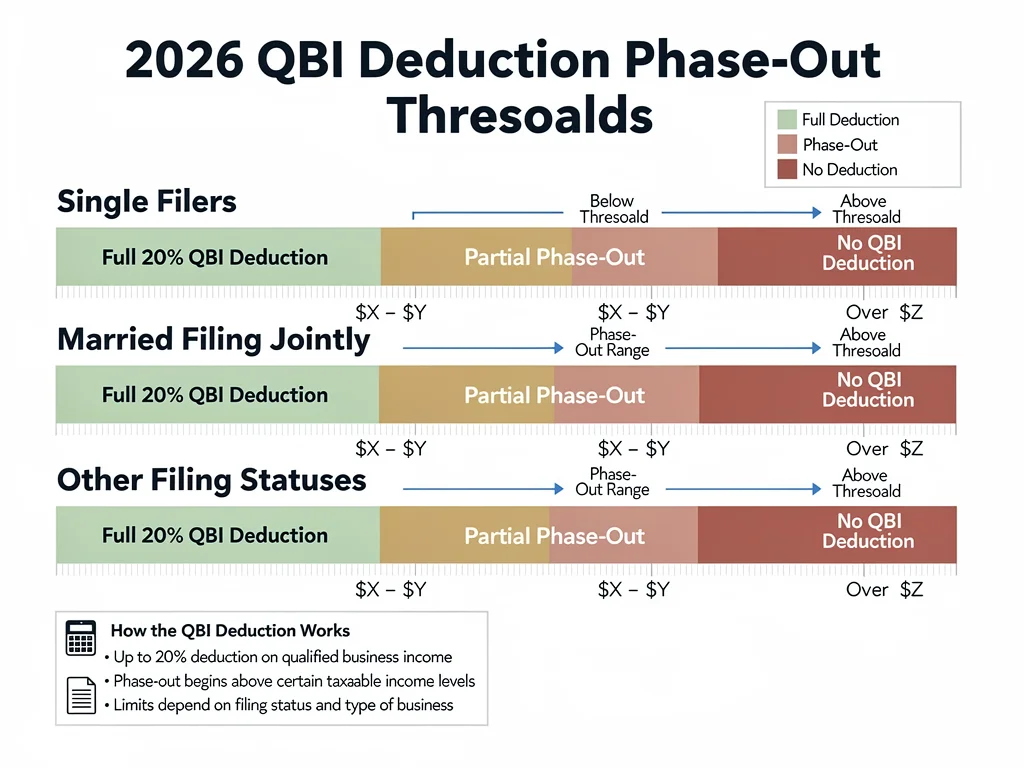
The phase-out thresholds are specific taxable income levels. Below the lower threshold, the full deduction is generally allowed. Within the phase-out range, the deduction is limited by W-2 wages and qualified property. Above the upper threshold, the deduction can be significantly reduced or eliminated, especially for SSTBs.
What is an SSTB, and how does it affect my QBI deduction?▼
An SSTB (Specified Service Trade or Business) is a business where the principal asset is the skill or reputation of its owners/employees, like law or health. SSTBs face stricter QBI deduction phase-out rules, meaning their deduction is eliminated at lower taxable income levels compared to non-SSTBs.
Can increasing W-2 wages help maximize my QBI deduction?▼
Yes, for businesses whose taxable income is within the phase-out range, increasing W-2 wages paid by the business can help maximize the QBI deduction. The deduction is limited by the greater of 50% of W-2 wages or 25% of W-2 wages plus 2.5% of qualified property’s unadjusted basis.
When should I consult a tax professional about QBI deduction planning?▼
It’s advisable to consult a tax professional as soon as possible, ideally well before the end of 2025. Early planning allows for strategic adjustments to income, expenses, and business operations to optimize your QBI deduction for the 2026 tax year and beyond.
Conclusion
The upcoming QBI deduction phase-outs for 2026 represent a critical juncture for small business owners and self-employed individuals. While the deduction continues to offer substantial tax relief, its effectiveness will increasingly hinge on a thorough understanding of the new inflation-adjusted thresholds, the specific rules for Specified Service Trades or Businesses, and the strategic importance of W-2 wages and qualified property. Proactive and informed planning is not merely beneficial but essential to navigate these complexities. By engaging with tax professionals, meticulously projecting income and expenses, and considering various optimization strategies, taxpayers can confidently approach 2026, ensuring they maximize their eligible 20% deduction and secure their financial well-being in an evolving tax landscape.
I'm a content creator fueled by the idea that the right words can open doors and spark real change. I write with intention, seeking to motivate, connect, and empower readers to grow and make confident choices in their journey.