Claiming Social Security Spousal Benefits: Your Guide to 50% Partner Rate
Advertisements
Social Security spousal benefits can provide an eligible husband, wife or qualifying divorced spouse with a payment based partly on another worker's Social Security record.
The maximum regular spousal benefit can equal 50% of the worker's Primary Insurance Amount, but reaching that percentage depends on the claiming spouse's age and eligibility.
Understanding the distinction between retirement, spouse and survivor benefits is essential because each category follows different claiming rules and can produce very different monthly amounts.
How Social Security Spousal Benefits Work
A spouse can potentially receive benefits on the earnings record of a worker who is entitled to Social Security retirement or disability benefits.
For an ordinary current-spouse claim, the worker generally must already be receiving the retirement or disability benefit before the spouse can receive payments on that record.
Different rules apply to some divorced spouses, who may qualify even when an eligible former spouse has not actually filed for retirement benefits.
Who Can Qualify as a Current Spouse?

The Social Security Administration says an eligible spouse generally can qualify beginning at age 62 or at any age while caring for an entitled qualifying child.
The child-in-care rule can apply when the child is under age 16 or has a qualifying disability and receives benefits on the worker's record.
For most current-spouse claims, the marriage also must have lasted at least one year, although SSA recognizes specific exceptions.
What the 50% Spousal Benefit Really Means
The frequently quoted 50% figure refers to the maximum regular spouse benefit based on the worker's Primary Insurance Amount rather than simply half of the worker's current check.
The PIA is generally the amount associated with the worker's own retirement benefit at full retirement age before delayed retirement credits are added.
An eligible spouse who waits until their own full retirement age can receive up to half of that underlying amount, subject to other applicable rules.
Delayed Retirement Credits Do Not Raise the 50% Base
A worker may delay retirement benefits beyond full retirement age and earn delayed retirement credits that increase the worker's own monthly payment.
Those credits do not increase the maximum regular spouse benefit above 50% of the worker's full-retirement-age amount.
They can, however, matter later for a qualifying surviving spouse because survivor benefits can reflect delayed retirement credits earned by the deceased worker.
Your Own Claiming Age Matters
A person does not automatically receive the full 50% merely because their spouse has reached full retirement age or delayed retirement.
If the claiming spouse starts regular spousal benefits before their own full retirement age, the monthly spouse benefit is generally permanently reduced.
Waiting beyond the spouse's own full retirement age does not create delayed retirement credits on the spousal portion itself.
Full Retirement Age Is Usually Between 66 and 67
The retirement full retirement age depends on year of birth and reaches age 67 for people born in 1960 or later.
Waiting until that applicable FRA allows the claimant to receive the unreduced regular spouse benefit if all other eligibility requirements are satisfied.
Someone considering an early claim should therefore compare the permanently reduced payment with the financial need to begin receiving benefits sooner.
Your Own Retirement Benefit Is Checked Too
Many people eligible for a spouse benefit also earned Social Security credits through their own employment and qualify for retirement on their own record.
SSA generally determines the person's own retirement benefit first and then determines whether the spouse calculation produces a higher total entitlement.
The result is not normally two complete benefits added together, even though the payment can contain an additional spouse component.
The Excess Spousal Benefit Fills the Difference
If the claimant's own retirement benefit is lower than the amount payable under the spouse rules, SSA can pay an additional spouse amount.
The combined payment brings the person to the higher applicable total rather than paying both full benefit amounts independently.
SSA summarizes this by explaining that people eligible for both retirement and spouse benefits receive the higher combined amount for which they qualify.
Deemed Filing Limits Older Claiming Strategies
Deemed filing is one of the most important rules for people who qualify for both their own retirement benefit and a spouse benefit.
For people born January 2, 1954 or later, filing for one of these benefits generally means they are considered to have filed for the other when eligible.
This prevents most modern claimants from taking only a spouse benefit while intentionally leaving their own retirement benefit untouched to grow with delayed retirement credits.
Restricted Applications Are Now Mostly Historical
Older retirement strategies sometimes relied on filing a restricted application for spouse benefits while postponing an individual's own retirement claim.
That option was preserved only for a limited grandfathered group born before January 2, 1954 and subject to the rules applicable to their circumstances.
For younger claimants, current planning should begin with deemed filing rather than relying on articles describing strategies that no longer apply broadly.
File and Suspend Is No Longer the Old Strategy
Another historical strategy involved one worker filing for retirement and then suspending payments so a spouse could claim while the worker earned delayed credits.
Federal changes eliminated the broad usefulness of that approach for newer suspensions, making many older retirement-planning articles obsolete.
Couples should therefore verify current SSA rules before using a claiming method described in pre-2016 guidance or older financial discussions.
Coordinated Planning Still Matters
The disappearance of older loophole-like strategies does not mean couples have no meaningful decisions left about Social Security timing.
Each spouse's age, own retirement benefit, health, employment, other retirement income and possible future survivor benefit can still affect the household outcome.
The goal should be evaluating realistic household scenarios rather than assuming one claiming age is optimal for every married couple.
Divorced Spouses Follow Special Rules
An unmarried divorced person can potentially claim a spouse benefit based on a former spouse's record when the marriage lasted at least 10 years.
The claimant generally must be at least age 62 and meet the other entitlement requirements governing divorced-spouse benefits.
Receiving a divorced-spouse benefit does not reduce the former spouse's own benefit or the benefit payable to the former spouse's current spouse.
The Two-Year Divorce Rule Can Matter
A divorced spouse may sometimes qualify even when the worker has not yet filed for retirement benefits, provided the worker is at least 62 and otherwise eligible.
For this independent divorced-spouse entitlement, the divorce generally must have been final for at least two continuous years.
This is an important difference from a current married spouse, whose ordinary spouse benefit generally requires the worker to have filed.
The 50% Rule Also Applies to Divorced Spouses
A qualifying divorced spouse can receive up to 50% of the former spouse's PIA when claiming at the appropriate full retirement age.
Claiming before FRA can reduce the divorced-spouse benefit under rules comparable to those applying to a current spouse.
The former spouse's subsequent marriage does not by itself eliminate an otherwise eligible divorced person's right to claim on that record.
Remarriage Usually Changes Divorced-Spouse Eligibility
Regular divorced-spouse benefits generally require the claimant to be unmarried at the time entitlement applies.
Remarriage can therefore prevent payment on a living former spouse's record while the new marriage remains in effect.
Survivor benefits follow a different remarriage framework, another reason regular spouse and survivor rules should not be combined into one category.
Survivor Benefits Are Not Spousal Benefits
A surviving spouse benefit is a separate Social Security benefit available after an insured worker dies and should not be described merely as a higher spouse benefit.
Eligible widows and widowers can generally begin survivor benefits at age 60, or from age 50 when qualifying under disability rules.
The maximum survivor payment can reach 100% of the applicable deceased worker benefit rather than the 50% maximum associated with ordinary spouse benefits.
Survivor Benefits Offer Different Claiming Flexibility
Deemed filing does not treat retirement and survivor benefits in exactly the same way that it treats retirement and regular spouse benefits.
An eligible surviving spouse may sometimes claim one benefit first and later switch to another if that strategy produces a larger payment.
This flexibility can make survivor planning substantially different from planning for a living spouse's regular benefit.
Survivor Full Retirement Age Is Its Own Concept
Social Security uses a full retirement age for survivor benefits that can differ from the retirement FRA applicable to the person's own retirement claim.
The SSA states that survivor FRA falls between ages 66 and 67 depending on the person's date of birth.
Waiting until survivor FRA can produce the maximum applicable survivor benefit, while starting earlier generally produces a reduced amount.
Survivor Payments Can Range From Reduced to Full Benefits
SSA states that surviving-spouse payments can generally range from 71.5% to 100% of the deceased spouse's applicable benefit depending on claiming age.
The actual calculation can also be affected by the deceased worker's claiming history and other Social Security rules.
That range should not be confused with the separate 50% maximum that applies to a regular spouse benefit while the worker is alive.
Working Before FRA Can Temporarily Reduce Payments
A person can work while receiving Social Security retirement or family benefits, but an earnings test can apply before full retirement age.
For 2026, the annual earnings-test exempt amount for someone under FRA throughout the year is $24,480.
SSA withholds $1 in benefits for every $2 of covered earnings above that lower annual threshold.
A Different Limit Applies in the Year You Reach FRA
For someone reaching full retirement age during 2026, the special annual limit is $65,160 for earnings in the months before FRA.
SSA withholds $1 in benefits for every $3 earned above that applicable higher limit during those pre-FRA months.
Beginning with the month the person reaches full retirement age, the retirement earnings test no longer applies.
Benefits Withheld Under the Earnings Test Are Not Simply Lost
The earnings test can reduce current payments for beneficiaries who work and earn above the applicable limit before reaching full retirement age.
However, Social Security later recalculates the retirement benefit to account for months in which benefits were withheld because of excess earnings.
This makes the earnings test different from an ordinary permanent tax or penalty on every dollar earned during retirement.
Only Certain Earnings Count Toward the Test
The retirement earnings test generally focuses on wages and net earnings from self-employment rather than every form of household income.
Investment income, pensions and many other non-work income sources do not operate like wages for purposes of this particular test.
People continuing to work while claiming should verify which income is counted instead of applying the annual threshold to their total cash flow.
Family Maximum Rules Can Affect Household Payments
Social Security limits the total amount that can normally be paid to certain family members on one worker's earnings record.
If several eligible family members receive benefits simultaneously, individual auxiliary payments can sometimes be reduced to remain within that family maximum.
The worker's own retirement benefit is handled separately from reductions allocated among eligible family members.
Divorced-Spouse Benefits Receive Different Treatment
SSA states that payments to qualifying divorced spouses do not count toward the worker's family maximum in the same manner as current-family auxiliary benefits.
This means a former spouse's qualifying claim generally does not reduce benefits payable to the worker's current family through the family-maximum calculation.
The distinction is especially useful when a worker has both a current spouse and one or more qualifying former spouses.
The Worker Usually Must Have Filed
For a currently married spouse, regular family benefits generally become available when the worker is receiving Social Security retirement or disability benefits.
This requirement prevents a current spouse from ordinarily collecting a spouse benefit solely because the worker reached age 62 but chose not to file.
The independently entitled divorced-spouse rules create the major exception when the statutory conditions, including the two-year divorce requirement, are satisfied.
Disability Benefits Can Also Support Spouse Eligibility
Family benefits are not limited to households where the worker receives retirement benefits because an insured worker receiving Social Security Disability Insurance can also have eligible family members.
An eligible spouse may qualify at age 62 or under the child-in-care rules while the worker receives disability benefits.
Benefit calculations and family-maximum rules should still be verified for the individual record rather than assuming the same dollar amount applies in every case.
Marriage Duration Rules Have Exceptions
The standard current-spouse rule generally requires the marriage to have lasted at least one year before spouse benefits become payable.
SSA explains that the one-year requirement does not apply when the claimant is the parent of the worker's child.
Other limited exceptions can apply based on entitlement to certain prior Social Security or Railroad Retirement benefits immediately before the marriage.
Survivor Marriage Duration Is Different
Surviving spouses generally face a different marriage-duration requirement from the one-year rule associated with ordinary current-spouse benefits.
SSA states that a surviving spouse ordinarily must have been married for at least nine months before the worker's death, subject to exceptions.
Surviving divorced spouses generally use the separate 10-year marriage rule when claiming on the former spouse's record.
Applying for Spousal Benefits
Applicants should gather identifying and relationship information before starting a claim so SSA can locate both records and verify entitlement.
Depending on the circumstances, this can include Social Security numbers, dates of birth and documentation relating to marriage, divorce or other eligibility factors.
SSA can request additional evidence if information already available in government records is not sufficient to establish the claim.
SSA Can Determine Which Benefit Is Higher
People age 62 or older applying for spouse benefits are generally evaluated for retirement benefits on their own record as well.
SSA determines the applicable payments using the deemed-filing and dual-entitlement rules rather than requiring the claimant to calculate an excess spouse amount independently.
Official estimates can help before filing, but the final entitlement calculation comes from the claimant's actual earnings records and application details.
Do Not Assume Waiting Until Age 70 Raises the Spouse Benefit
Waiting beyond FRA can continue increasing a worker's own retirement benefit through delayed retirement credits until the applicable maximum delay age.
An ordinary spouse benefit does not receive those delayed credits and therefore does not keep increasing from 50% simply because the spouse waits until age 70.
This distinction can prevent couples from postponing a spouse claim based on an expected increase that does not actually apply to that component.
Delaying the Higher Earner Can Still Help a Survivor
The higher earner's delayed retirement credits can still have significant household value because they can increase the potential benefit payable to a surviving spouse.
This means a decision to delay the higher earner may be motivated partly by survivor protection even though it does not raise the regular spouse benefit above 50%.
Couples comparing claiming strategies should therefore consider both lifetime retirement payments and the income available after the first spouse dies.
Social Security Benefits Receive Annual COLAs
Social Security benefits can change over time through annual cost-of-living adjustments intended to reflect inflation under the program's statutory formula.
For 2026, Social Security benefits received a 2.8% COLA, increasing benefit amounts from their 2025 levels.
A spouse benefit expressed as a percentage rule should therefore not be confused with a permanently fixed dollar amount throughout retirement.
Average Benefits Are Not Individual Estimates
SSA reported an estimated average retired-worker benefit of $2,071 per month after the 2026 COLA, but individual amounts vary substantially.
Average spouse-benefit figures similarly cannot determine what one specific claimant will receive because the calculation depends on the worker's record and claiming circumstances.
Personalized SSA estimates are more useful for planning than applying national average benefit amounts to an individual household.
Check Current Rules Instead of Old Strategies
Social Security claiming advice is particularly vulnerable to becoming outdated because legislative changes can eliminate strategies that remain widely discussed online for years.
Older articles about file-and-suspend or restricted applications may describe opportunities that no longer exist for most people approaching retirement today.
Readers should prioritize current SSA material and current Social Security updates when evaluating retirement decisions.
Official Rules Should Control the Decision
Financial articles can help explain Social Security concepts, but they cannot replace the eligibility determination made from SSA's official records and regulations.
Claims involving divorce, disability, survivor status or multiple benefit types can become particularly complicated because several provisions may interact.
Broader discussions of Social Security reform and policy changes should therefore be separated from rules already in effect.
When Professional Advice May Be Useful
Many straightforward spouse claims can be understood using SSA estimates and official explanations without paying for a separate financial-planning service.
More complex households may benefit from qualified advice when retirement timing interacts with taxes, pensions, investment withdrawals and survivor-income planning.
Any adviser should distinguish clearly between official entitlement rules and projections about which claiming strategy might maximize lifetime household income.
Lifetime Maximization Is Not the Only Goal
A strategy producing the highest modeled lifetime Social Security total may still require delaying income during years when a household needs cash flow.
Health, longevity expectations, employment and available savings can all influence whether delaying a claim is practical.
A sound decision therefore balances expected lifetime value with immediate financial needs and the uncertainty inherent in forecasting future circumstances.
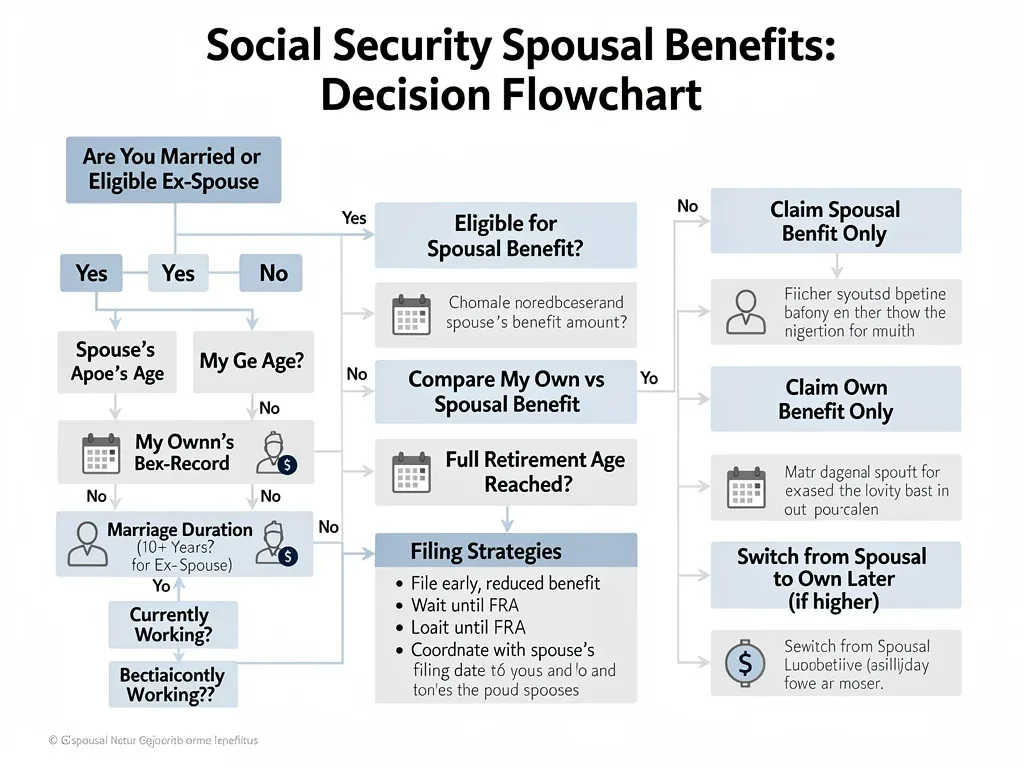
Social Security Spousal Benefits at a Glance
Social Security spousal benefits can supplement a lower-earning spouse's retirement income, but the commonly quoted 50% represents a maximum under specific circumstances.
Claiming before FRA, receiving a larger benefit on one's own record or failing to meet relationship requirements can change or eliminate the spouse payment.
The table below summarizes the major distinctions readers should understand before making a claiming decision.
Separate Spouse and Survivor Rules
Regular spouse benefits while the worker is alive generally reach no more than 50% of the worker's PIA under the spouse calculation.
Survivor benefits after the worker's death follow a different framework and can reach 100% of the applicable deceased-worker benefit.
Confusing these two systems can lead to incorrect expectations about both claiming ages and the amount eventually payable.
Key Rule | How It Works |
|---|---|
Maximum Regular Spouse Benefit | Up to 50% of the worker's Primary Insurance Amount when the claiming spouse reaches the applicable FRA. |
Minimum Claiming Age | Generally age 62, unless the spouse qualifies under child-in-care rules. |
Current Marriage Duration | Generally at least one year, with specific exceptions. |
Divorced Spouse | Generally requires a marriage lasting at least 10 years and the claimant to be unmarried. |
Deemed Filing | For most modern claimants, filing for retirement or spouse benefits means filing for both when eligible. |
Survivor Benefit | Separate benefit that can reach up to 100% of the applicable deceased-worker amount. |
2026 Earnings Test | $24,480 for those under FRA all year; special $65,160 limit applies in the year FRA is reached before the FRA month. |
Frequently Asked Questions About Spousal Benefits
What is the maximum Social Security spouse benefit?
The regular spouse benefit can generally equal up to 50% of the worker's Primary Insurance Amount when the spouse claims at the applicable full retirement age.
Does my spouse need to file before I can receive benefits?
Generally yes for a current spouse, while qualifying divorced spouses can sometimes claim independently after meeting the applicable two-year divorce rule.
Can I receive my full retirement benefit plus 50% of my spouse's?
No. SSA generally pays your own retirement benefit first and adds only enough spouse benefit to reach the higher applicable total.
Does waiting until age 70 increase my spouse benefit?
No. Regular spouse benefits do not earn delayed retirement credits beyond FRA, although the worker's delayed credits can increase a future survivor benefit.
Can I take only a spouse benefit while my own benefit grows?
Most people born January 2, 1954 or later cannot use that strategy because deemed filing generally applies to retirement and spouse benefits.
Can an ex-spouse receive benefits on my record?
Potentially, if eligibility requirements are met, including generally a marriage lasting at least 10 years, age 62 or older and unmarried status.
Does an ex-spouse's claim reduce my benefit?
No. A qualifying divorced-spouse claim does not reduce the worker's own benefit or the benefit payable to a current spouse.
Are survivor benefits limited to 50%?
No. Survivor benefits are separate from regular spouse benefits and can reach as much as 100% of the applicable deceased-worker benefit.
Can I work while receiving a spouse benefit?
Yes, but payments can be temporarily withheld under the retirement earnings test when you are under FRA and earnings exceed the applicable annual limit.
What is the earnings limit for 2026?
The standard 2026 limit is $24,480 for someone under FRA all year, while a special $65,160 limit applies before FRA during the year FRA is reached.
Conclusion
Social Security spousal benefits can provide up to 50% of a worker's full-retirement-age amount, but that maximum applies only when the eligibility and claiming-age requirements are satisfied.
Deemed filing, early-claim reductions, divorced-spouse rules and the distinction between regular spouse and survivor benefits can substantially change the amount actually received.
Using current SSA rules and personalized benefit records is the safest way to evaluate a claim rather than relying on outdated strategies or assuming that every spouse automatically receives half of a partner's monthly check.